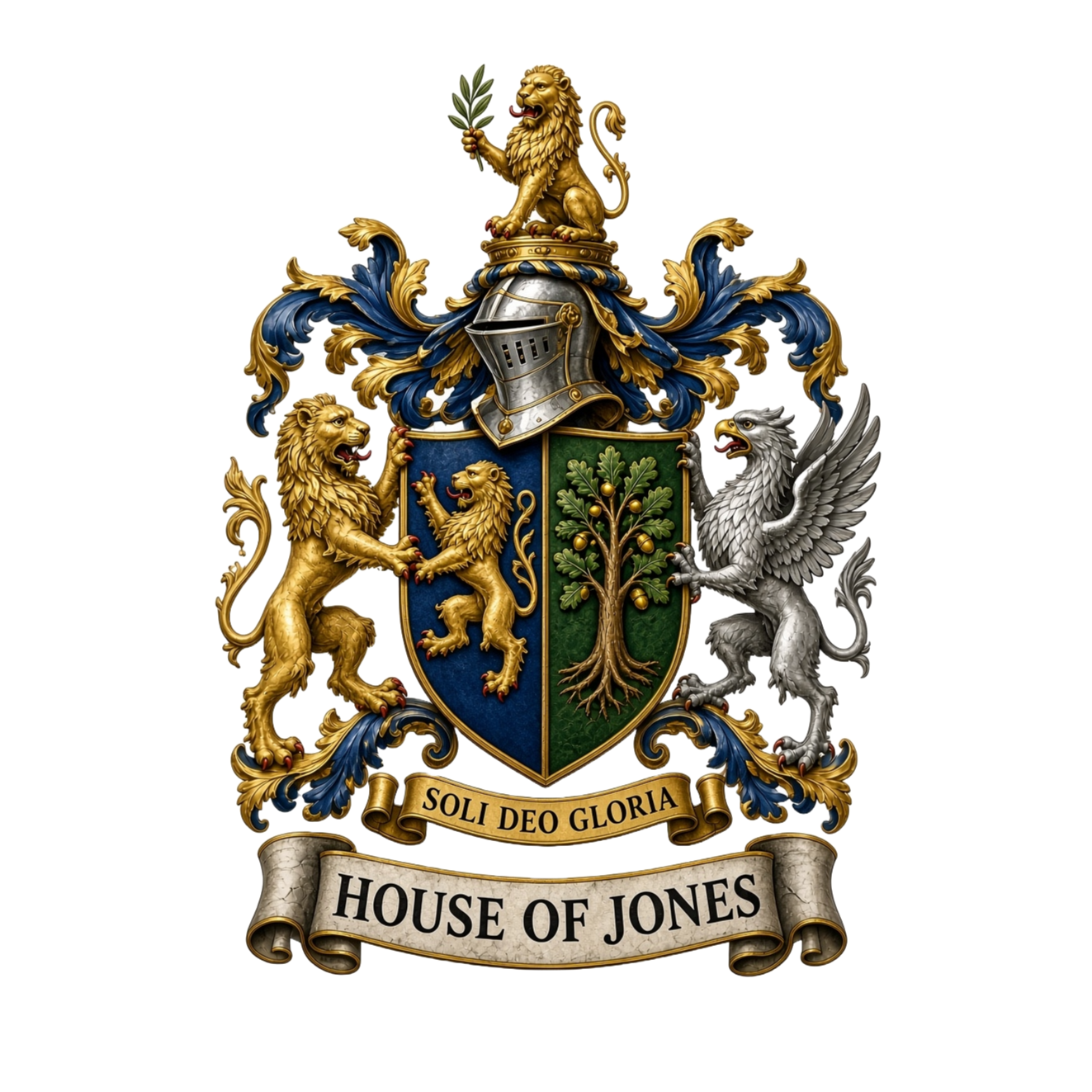
The House of Jones
Traditional Heraldic & Lineage Register
The heraldic history of the House of Jones is deeply rooted in Welsh lineage, where the traditional patronymic naming system (ap Siôn / "son of John") eventually consolidated into one of the most prominent armigerous surnames across Wales, England, and Ireland[1].
1. Welsh Roots & Principal Seats
- Origins: The earliest documented lineages trace back to 11th-century medieval Welsh nobility and gentry across historical counties like Denbighshire, Meirionydd, and Glamorgan[2].
- Fonmon Castle Lineage: One of the most famous landed branches was established by Colonel Philip Jones (1618–1674)[3]. A key Parliamentarian officer and Governor of Swansea, he acquired Fonmon Castle in 1654, which remained a major historic seat held by his direct descendants for centuries[4].
- Llanerchrugog & Denbighshire: Other prominent Welsh gentry branches held ancestral seats across North Wales, serving as High Sheriffs, Members of Parliament, and custodians of regional law[5].
2. Dynastic Peerages & Nobility
The surname yielded several major titles within the Peerage of Great Britain and Ireland[6]:
| Title | Historic Seat / Region | Key Details |
|---|---|---|
| Viscount Ranelagh (Peerage of Ireland) |
Navan, Co. Meath / London | Created in 1628 for Sir Roger Jones (son of Thomas Jones, Archbishop of Dublin)[7]. The lineage produced prominent politicians, military leaders, and courtiers[8]. |
| Earl of Ranelagh | Ranelagh House, Chelsea | Created in 1674 for Richard Jones, 3rd Viscount Ranelagh[9]. His estate and gardens later became the famous Ranelagh Pleasure Gardens in London[9]. |
| Jones Baronets | Abermarles, Carmarthenshire & Boultibrook | Created across various centuries for military service and judicial contributions (such as Lord Chief Justice Sir William Jones)[10]. |
3. Core Heraldic Blazons & Symbols
Because the surname emerged from distinct patronymic roots, there are a few primary coats of arms associated with the major historic branches of the house[11]:
The Primary Noble Shield
- Blazon: Azure, a cross between four pheons points downwards Or[11].
- Symbolism:
The Welsh Rampant Shield
- Blazon: Gules (or Or), a lion rampant Azure (or Gules) within a border[15].
- Symbolism: The lion rampant is a cornerstone of medieval Welsh royal heraldry, symbolizing nobility, courage, and strength[16].
Crest & Motto
- Crest: Frequently features a dexter arm embowed in armour, holding a dart or spear proper, or a demi-lion rampant[17].
- Historic Mottoes:
Bibliography & References
- Burke, Sir Bernard. The General Armory of England, Scotland, Ireland, and Wales. London: Harrison & Sons, 1884. (Patronymic Welsh Armigerous Surnames).
- Nicholas, Thomas. Annals and Antiquities of the Counties and County Families of Wales. London: Longmans, Green, Reader & Co., 1872.
- Cokayne, George E. Complete Baronetage and Landed Gentry of Great Britain. London: William Pollard & Co., 1900.
- Royal Commission on the Ancient and Historical Monuments of Wales. An Inventory of the Ancient Monuments in Glamorgan: Domestic Architecture. HMSO, 1981 (Fonmon Castle Records).
- Dwnn, Lewys. Heraldic Visitations of Wales and Part of the Marches. Edited by Sir Samuel Rush Meyrick. Welsh MSS Society, 1846.
- Debrett, John. Debrett's Peerage of the United Kingdom of Great Britain and Ireland. London: J.G. & F. Rivington, 1836.
- Lodge, John. The Peerage of Ireland; or, A Genealogical History of the Present Nobility of that Kingdom. Dublin: James Moore, 1789 (Viscountcy of Ranelagh).
- Haydn, Joseph. The Book of Dignities: Containing Rolls of the Official Personages of the British Empire. London: Longmans, Green, and Co., 1890.
- Lysons, Daniel. The Environs of London: Volume 2, County of Middlesex. London: T. Cadell and W. Davies, 1795 (Ranelagh Estate & Pleasure Gardens).
- Foss, Edward. The Judges of England; with Sketches of their Lives. London: Longman, Brown, Green, and Longmans, 1857.
- Fox-Davies, Arthur Charles. A Complete Guide to Heraldry. London: T.C. & E.C. Jack, 1909.
- Elvin, Charles Norton. A Hand-Book of Mottoes Borne by the Nobility, Gentry, Cities, S.I.. London: Bell and Daldy, 1860.
- Woodward, John. A Treatise on Heraldry, British and Foreign: With English and French Glossaries. Edinburgh: W. & A.K. Johnston, 1896.
- Fox-Davies, Arthur Charles. The Art of Heraldry: An Encyclopaedia of Armory. London: T.C. & E.C. Jack, 1904.
- Boutell, Charles. English Heraldry. London: Cassell, Petter, and Galpin, 1867.
- Siddons, Michael Powell. The Development of Welsh Heraldry. Aberystwyth: National Library of Wales, 1991.
- Fairbairn, James. Fairbairn's Book of Crests of the Families of Great Britain and Ireland. Edinburgh: T.C. & E.C. Jack, 1905.
- Elvin, Charles Norton. A Hand-Book of Mottoes Borne by the Nobility, Gentry, Cities, S.I.. London: Bell and Daldy, 1860.